TWO ARTICLES THAT STUCK WITH US
Because they described how we already work.
Lately, particularly two articles have stuck with us.
Not because they felt like predictions — but because they felt like a mirror.
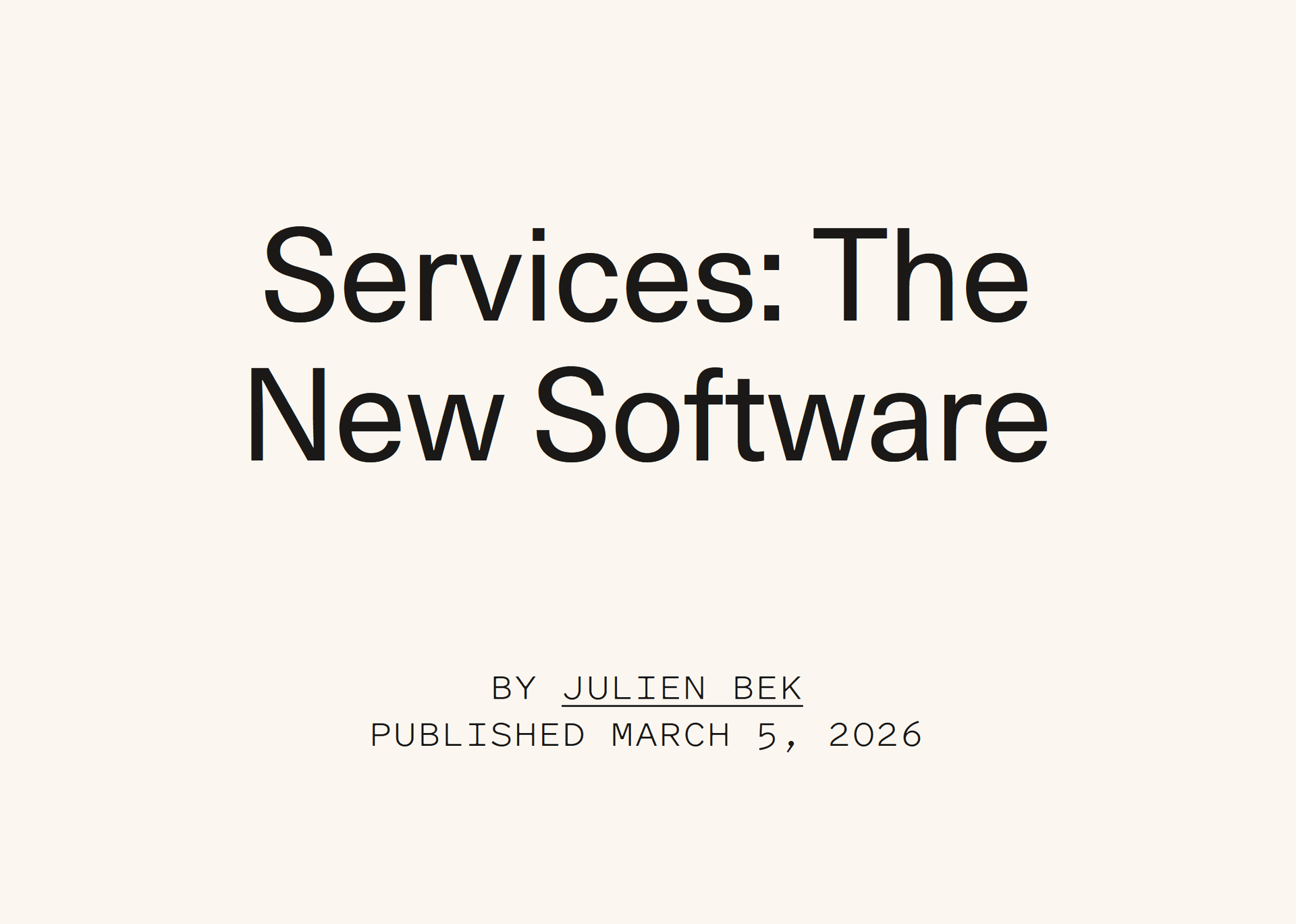
One was Say Goodbye to the Billable Hour, Thanks to AI published by The Wall Street Journal. The other — spoiler alert, we're not claiming to become the next trillion dollar company — was Services: The New Software from Sequoia Capital.
And reading them, the reaction wasn't: "This is interesting." It was: "This is exactly what we've been experiencing."
Not theoretically — but in how we've actually been building and operating over the past months.
It's been genuinely rewarding to see our own way of working reflected so clearly — simply by following what worked.
The previous months we just followed what worked
We didn't sit down and decide to "reinvent consulting" or "build AI-native systems."
We just kept asking: How can we together with our client not only define the problem — but actually solve it?
And step by step, that led us somewhere different.
Less slides. Less handovers. Less "final deliverables." More building. More testing. More things that actually run.
Only in hindsight, those two articles put a label on it: With current technology, we're not just delivering services more efficiently — we're moving towards something else entirely.
When speed breaks the old model
The biggest unlock has been speed.
What used to take weeks now takes days. Sometimes hours.
And once you experience that, a lot of things stop making sense. Like billing based on time.
Because if the outcome is better and faster, why should the value decrease?
It becomes obvious that: The value is no longer in the time spent — but in how fast you can turn a problem into something that works, towards fix price.
We've stopped thinking in projects — and started thinking in solutions
Another shift we've noticed: We rarely think in "projects" anymore.
Instead of asking "What's the scope and deliverable?" we ask: "What's the most efficient existing tools and systems we can build that solves this?"
And the outputs reflect that. Not PDFs. Not recommendations. But: demos and prototypes in days, real products running 24/7 within weeks, internal tools, and automated workflows replacing manual processes.
That's where things get interesting. Because at that point, you're not really delivering a traditional service anymore. You're co-creating something at incredibly high pace.
This is where we see our company going
Those two articles didn't change our direction. They confirmed it.
Because if this is how value is created now, then the question becomes: What kind of company do you build around that?
For us, it's not a traditional consultancy, or a pure SaaS company. It's a new kind.
A company that turns business problems into working systems — fast, with a free demo within 48 hours after the first meeting.
Where clients don't just get advice — but something that actually runs, and keeps delivering value over time.
It already feels like the default
What's maybe most surprising is how normal this already feels.
This isn't some future vision. It's how we've been operating lately: building demos and prototypes in days, replacing manual processes with simple automations, focusing on what works — not how it's packaged.
And once you've worked like that, it's very hard to go back.
Final thought
Sometimes, you read something and think: "That might happen."
And sometimes, you read something and realize: "This is already happening — and we're in the middle of it."
These two articles did exactly that for us. They didn't just describe a trend. They captured how we've been working — and where we see our company heading next.